 Customer Service: (253) 677-0290
 Customer Service: (253) 677-0290
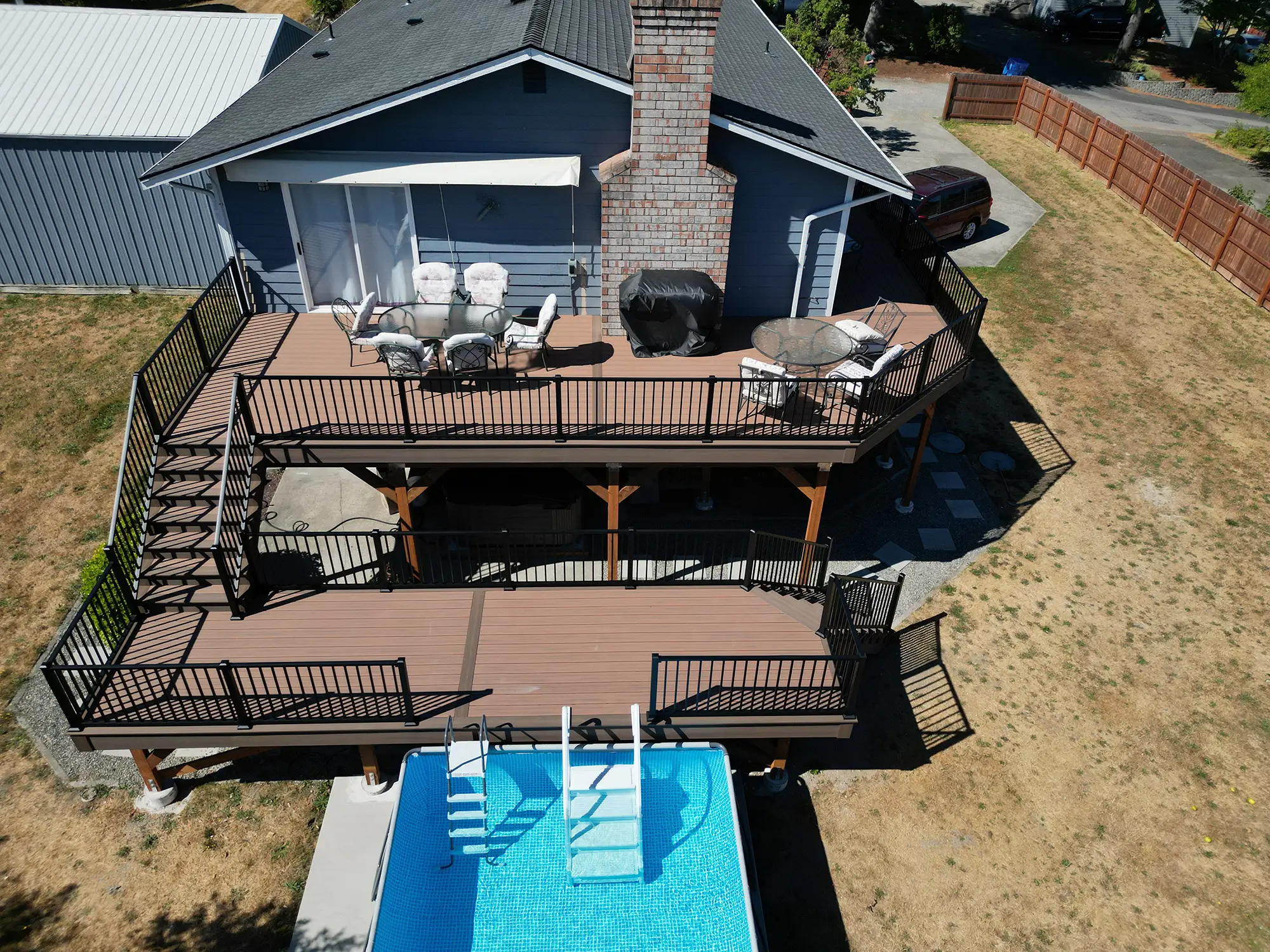
By Daniel Rotaru, Owner and CEO at Decks Restore. WA Contractor License # CC DECKSRL797P2. Tacoma, WA.
The pitch is always the same. Put a ceiling under your elevated deck, gain a dry patio, hang a TV out there, use the space year round. I have installed a lot of these systems and I still think it is one of the better upgrades you can make to a Tacoma house.
I have also torn out four of them, all installed by somebody else, all rotted, all less than nine years old.
The difference between those two outcomes is not the brand. It is which of the two basic designs got installed, and whether anyone thought about where the collected water goes. Most of the homeowners I talk to have no idea there are two designs, because the guy quoting them only sells one.
An above-joist system goes in before the decking. Troughs or a membrane sit on top of the joists, between them, and slope toward a gutter at the low end. Water hits your deck boards, falls through the gaps, lands in the trough, and leaves. It never touches the framing. Trex RainEscape and DEK Drain are the common ones.
A below-joist system is a ceiling. Panels, usually vinyl or aluminum, hang underneath the joists and catch water after it has already run across every joist, hanger, and fastener in the deck. Zip-Up and the various aluminum panel systems work this way. It is cheaper, it can be retrofitted to an existing deck, and it looks cleaner from below because you get a flat ceiling instead of the underside of your decking.
In Phoenix or Denver, the below-joist version is a reasonable trade. The framing gets wet, then it dries, and nothing bad happens.
Tacoma does not give you the drying part. We get somewhere around 38 inches of rain a year and most of it arrives between October and May, when the air is already saturated and the sun does not come out for weeks. A below-joist panel system creates a sealed, unventilated cavity around wet framing during the exact eight months when that framing cannot dry. That is not a drainage system. That is a rot incubator with a warranty.
All four of the rotted assemblies I tore out were below-joist. The panels themselves were fine. The joists above them were not.
If you are building new, install above-joist. It costs more, it has to be decided before the decking goes down, and it is the only version I will warranty in this climate. The framing stays dry, which means your hangers and fasteners stay dry too, and that matters more than people think. I went into why in Why Mercer Island Decks Rot From the Hardware Up, and everything in that post applies double inside a closed cavity.
If you have an existing deck and tearing off good decking is not in the budget, below-joist is your option, and it can work. It needs three things that most installers skip. Leave the perimeter open so air moves through the cavity rather than sealing it tight to the house and the beam. Use aluminum panels, not vinyl, because vinyl sags and cups within about five years here and then holds standing water. And get the framing inspected and treated before you close it up, because you are about to make it very hard to look at again.
I tell people to think of a below-joist retrofit as a ten year decision, not a permanent one. Plan on pulling a few panels at year five to look at the joists. If you are not willing to do that, do not install it.
There is a third option people forget: waterproof the deck surface itself with a membrane and put pavers or tile on pedestals over the top. Now the deck is a roof and nothing gets through at all. It costs the most and it changes the whole build, but on a deck over finished living space it is the only thing I will do. I compared how that assembly performs against conventional decking in Porcelain Pavers vs. Wood Decking on a Tacoma Rooftop.
This is the failure I see most, and it is not the drainage system failing. It is the drainage system working perfectly and creating a new problem twenty feet away.
Run the math on a 400 square foot deck. At 38 inches of annual rainfall, that deck sheds roughly 9,400 gallons a year. Before you installed under-deck drainage, that water fell through the boards and spread out across the whole footprint, soaking into the ground gradually. Now you have collected all of it and concentrated it into one downspout.
If that downspout empties onto a splash block next to your foundation, you have just built a machine that pumps nine thousand gallons a year against your crawlspace. I have been called out to diagnose a wet crawlspace and found the cause was an under-deck gutter installed two years earlier by a different contractor. The homeowner loved the dry patio. He had no idea it was the reason his crawl space smelled.
Tie the under-deck gutter into your existing downspout system, a drywell sized for the volume, or an approved storm connection. Get that decided in the quote, not on the last day of the job.
Two Tacoma specifics worth knowing before you sign anything. The City assesses a stormwater system development charge calculated per square foot of net increased impervious surface, so a large covered assembly can carry a fee that nobody mentioned in the sales meeting. And any stormwater work in the public right of way has to be done by a contractor licensed and bonded to work in the City of Tacoma, which is a narrower list than general contractors. Both are documented on the City’s stormwater permits and manuals page.
Fir and cedar needles clog troughs. This is the number one service call and it is entirely preventable. If you have a Douglas fir over the deck, the above-joist troughs will pack with needles in about two seasons and back water up into the joist bays. Debris guards at the gutter and a look every fall solves it.
Vinyl panels sag. Below-joist vinyl goes soft, cups in the middle, and holds an inch of standing water that then finds the seam. Aluminum with a proper pitch does not do this.
Gutters get pitched flat. An under-deck gutter needs real slope, and installers rush it because the run is short and hidden. Flat gutter plus Tacoma leaf load equals a full gutter.
Membranes get punctured during a re-deck. If you install above-joist drainage and later replace the boards, whoever does the re-deck will shoot fasteners through the membrane unless someone tells them it is there. Put a note in your file. Tell the next contractor. I have found this on decks where the original system was installed correctly and the second crew ruined it in a day.
Ledger flashing gets ignored. Under-deck drainage does not fix a bad ledger, and it hides the evidence that the ledger is bad. If your deck is attached to the house and the flashing is questionable, deal with that first. The 7-point deck safety checklist covers how to check it, and When “Just an Old Deck” Becomes a Whole House Problem is the version of this story where nobody caught it in time.
Figures below are for a 400 square foot elevated deck, installed, including the gutter and a tie-in to an existing downspout.
| System | When it can be installed | Installed cost | Realistic service life here | Yearly upkeep |
|---|---|---|---|---|
| Above-joist membrane and trough | New build or full re-deck only | $9 to $14 per sq ft, so $3,600 to $5,600 | 20 years plus, because the framing stays dry | Clear troughs each fall |
| Below-joist aluminum ceiling panels | Retrofit or new | $12 to $18 per sq ft, so $4,800 to $7,200 | 10 to 15 years, depending on ventilation | Clear gutter, pull panels at year five to inspect |
| Below-joist vinyl panels | Retrofit or new | $7 to $11 per sq ft, so $2,800 to $4,400 | 5 to 8 years before sagging starts | Same as above, plus expect replacement |
| Waterproof membrane with pavers on pedestals | New build or full rebuild | $28 to $45 per sq ft | 25 years plus | Sweep, check drains |
| Adding lighting, fan, and outlets to the space below | Any | $1,200 to $3,500 | Follows the deck | None |
The number worth pausing on is that above-joist is cheaper to install than below-joist aluminum and lasts longer. It only loses on one axis, which is that you cannot retrofit it without pulling your decking. If you are already planning a re-deck, do them together and you get the drainage for close to nothing extra in labor.
Sometimes the honest answer is that the space below is not worth it.
If the deck is less than about eight feet off the ground, you will not get usable headroom once panels and a gutter eat into it, and you will have built a dark crawl area you never sit in.
If the space below is a concrete patio you want to use in November, a solid cover over the patio does more for you than a ceiling under the deck, because it can extend past the deck footprint and it is not fighting the deck’s structure. That is where an acrylic patio cover or a louvered roof earns its money, and the louvered version gives you the option of opening it up in July.
If you do not have a deck yet and you are weighing an elevated deck against grade level hardscape, that is a different conversation entirely and I covered it in Is It Better to Have a Deck or Patio in Tacoma?
Adding drainage panels under an existing deck usually does not require a building permit by itself in Tacoma. What triggers permitting is structural work, electrical in the new covered space, connecting to the public storm system, or building any kind of roof structure. Electrical under a deck has to be wet-location rated and inspected, and that is not a place to save money.
We pull the permits on our jobs and coordinate inspections. If someone quotes you an under-deck system with lighting and tells you no permit is needed for the electrical, get a second quote.
The below-joist type can, in a wet climate, because it encloses framing that stays damp for months. Above-joist systems keep water off the framing entirely and do not have this problem. Every rotted under-deck assembly I have removed in Pierce County was a below-joist installation.
Yes, but only the below-joist ceiling type, unless you are pulling the decking off. Above-joist systems install on top of the joists and require the boards to come up.
Roughly $2,800 to $7,200 installed for a 400 square foot deck depending on the system, and $28 to $45 per square foot if you are waterproofing the deck surface with a membrane and pavers instead.
Usually not for the panels alone. You will need permits for electrical in the space below, for structural changes, and for any connection to the public storm drainage system.
Into your existing downspout system, a properly sized drywell, or an approved storm connection. Do not let it discharge next to the foundation. A 400 square foot deck concentrates around 9,400 gallons a year into that one outlet.
A well-installed system keeps direct rain off. Wind driven rain still comes in from the open sides, so if you want the space dry in a real storm you need side screening or a cover that extends past the deck.
Above-joist membranes commonly go 20 years or more. Aluminum below-joist panels run 10 to 15 years. Vinyl panels start sagging around year five here and I stopped installing them.
Daniel Rotaru is the owner of Decks Restore in Tacoma, Washington, and holds Washington State Contractor License CC DECKSRL797P2. He has built and repaired decks across Tacoma, Pierce County, and the South Sound for more than a decade, quotes every project himself, and walks active job sites daily. Completed under-deck and covered projects are in our project gallery.
Decks Restore 748 Market St #173, Tacoma, WA 98402 (253) 677-0290 Monday to Friday 9:00 AM to 5:00 PM, Saturday 9:00 AM to 2:00 PM WA LIC # CC DECKSRL797P2
We install under-deck drainage across Tacoma and serve Gig Harbor, Federal Way, Puyallup, Auburn, Kent, and Renton. If you want a written quote that specifies the system type and names the discharge point, contact us or call and ask for Daniel.
Planning a new build instead of a retrofit? Our Tacoma deck builder page covers materials, cost ranges, and the permit process, and Trex vs. TimberTech vs. Fiberon covers how the decking above the drainage has actually aged on our jobs.