 Customer Service: (253) 677-0290
 Customer Service: (253) 677-0290
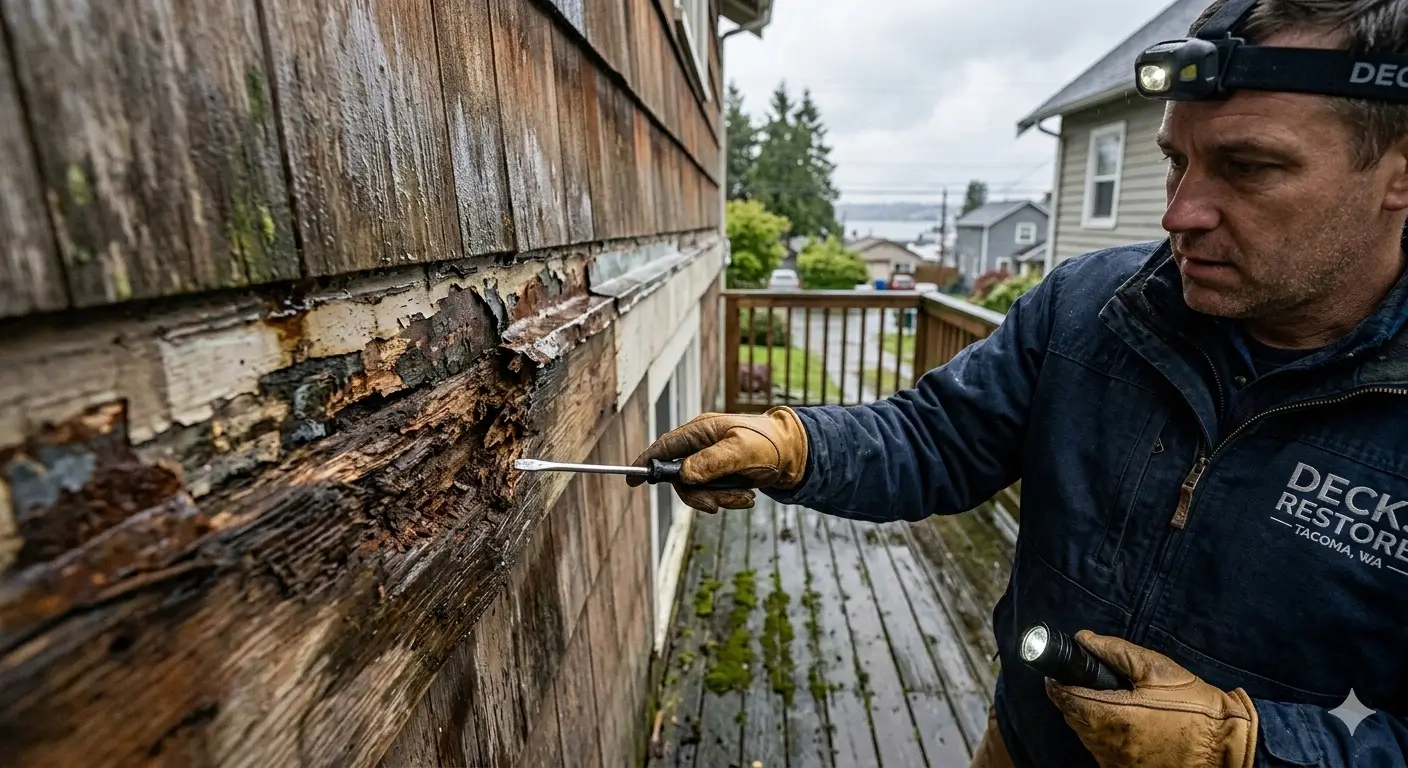
If you live in Tacoma, you know the drill: eight months of drizzle, moss growing on everything, and that one week of summer where we all pretend we don’t need AC. We love it here, but our houses—specifically our decks—take a brutal beating.
Most homeowners I talk to in the North End or over by Proctor look at their deck and see “ugly boards.” They think a power wash and some stain will fix it. But after years of doing this, I’ve learned that the real danger isn’t the wood you walk on—it’s the wood you can’t see.
There’s a single piece of lumber called the ledger board. It’s the “handshake” between your deck and your house. In our climate, if the flashing (that little metal lip) wasn’t installed perfectly by your Tacoma local deck builders, water doesn’t just sit there—it gets sucked behind the siding like a straw.
I’ve walked onto decks that looked “fine” from the street, only to find that the rim joist of the actual house had turned into the consistency of wet cake. When that happens, you aren’t just calling a deck guy; you’re calling a structural engineer.
You don’t need to be an expert to spot the red flags. If you’re out grilling this weekend, take a look for these:
We aren’t in Arizona. We deal with “micro-rot.” Our humidity stays high enough that wood never truly dries out between October and May. Older decks (built 15+ years ago) weren’t usually built with things like joist tape or modern Z-flashing—tools we use today specifically because we know how aggressive PNW moisture is.
| The “Old Way” (Pre-2010s) | Why It Fails in the PNW | The “Right Way” (Today) |
| No Joist Tape | Water sits on top of the joists, rotting the wood from the screw holes inward. | Butyl Joist Tape: A waterproof seal that acts like a raincoat for your framing. |
| Simple Metal Flashing | Rain blows behind the metal or seeps through nail holes into your house siding. | Integrated Z-Flashing: A multi-layered barrier that directs every drop of water away from the house. |
| Untreated Fasteners | Our salty, humid air eats cheap screws, causing “bleeding” and structural looseness. | Stainless or Triple-Coated: Fasteners designed to survive 20+ years of Washington rain. |
| Standard Wood Posts | Placing wood directly on concrete or in dirt leads to “wicking” and base rot. | Post-to-Pier Brackets: Keeping the wood 1–2 inches off the ground so it stays dry. |
I’m not saying you need to tear your deck down tomorrow. Most of the time, we can catch these issues early, swap out some flashing, and reinforce the framing before the rot reaches your kitchen floor.
If your deck is hitting its 15th birthday, it’s worth having someone who knows what they’re looking at crawl underneath and give it a real look. It’s a lot cheaper to fix a deck than it is to rebuild the side of a house.