 Customer Service: (253) 677-0290
 Customer Service: (253) 677-0290
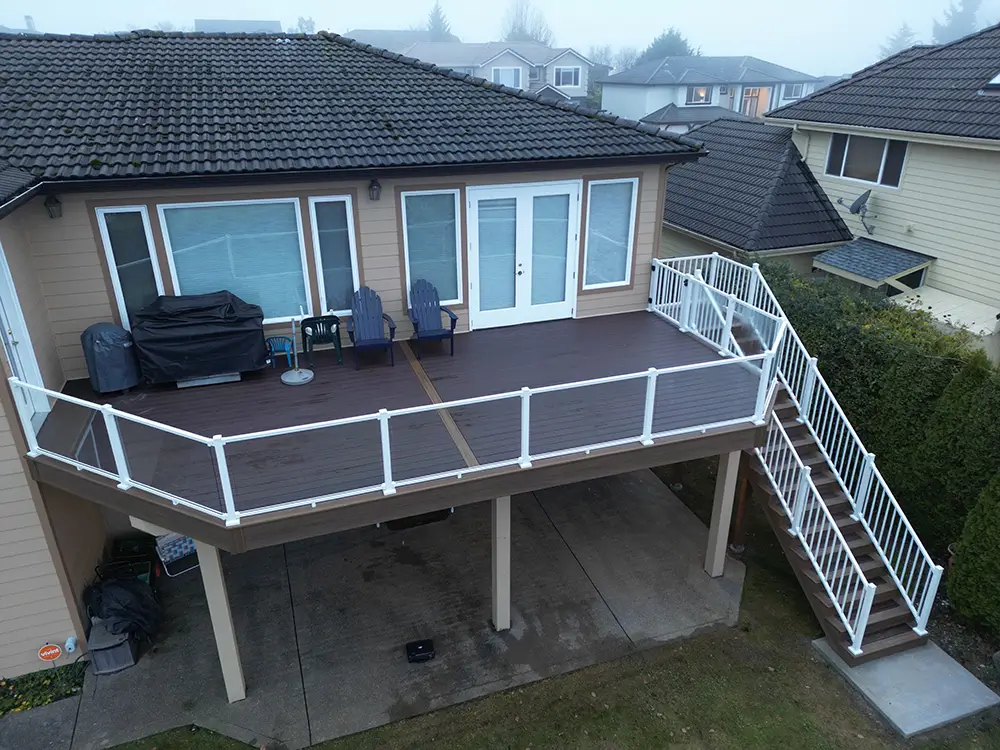
By Daniel Rotaru, Owner and CEO at Decks Restore. WA Contractor License # CC DECKSRL797P2. Tacoma, WA.
The call usually comes in October. Someone bought a hot tub, delivery is in eleven days, and the dealer said any solid deck will hold it. They want me to come out and confirm that, and they are hoping the visit takes fifteen minutes.
I have never once been able to say yes on the spot.
Not because Tacoma decks are badly built. Because a standard residential deck is engineered for a load that a hot tub roughly doubles, and no amount of the deck feeling solid underfoot tells you anything about that. A deck that bounces a little can be fine. A deck that feels like a concrete slab can be one that fails under a tub. Feel is not a load path.
This post is the arithmetic I walk homeowners through, why it lands where it does, and the three ways out.
Residential decks in Washington are designed to 40 pounds per square foot of live load plus about 10 psf of dead load. Call it 50 psf total. That covers people, furniture, a grill, a crowd at a barbecue.
Live load is spread out. That is the assumption baked into every joist span table your builder used.
Water weighs 8.34 pounds per gallon, which is the only figure in this post nobody argues with.
Take a common 7 by 7 foot tub. That is 49 square feet of footprint holding around 400 gallons.
Water: 3,336 pounds. Shell, cabinet, pumps, and heater: roughly 800 pounds dry. Five adults at 175 pounds: 875 pounds.
Total is a little over 5,000 pounds sitting on 49 square feet, which works out to about 102 psf.
Your deck was built for 50.
People assume a smaller tub solves it. Run a two-person 6 by 6 at 200 gallons and you get roughly 2,500 pounds over 36 square feet, or about 70 psf. Still 40 percent over the design load. Run a big 8 by 8 at 500 gallons and you land near 96 psf. Every hot tub on the market exceeds what a standard deck was built to carry. There is no small enough.
If the load were genuinely spread across 49 square feet, some decks could take it. It is not.
A portable hot tub bears on its cabinet base, so the weight transfers along the perimeter of the footprint and at whatever the manufacturer designed as bearing points. Whichever two or three joists happen to sit under that perimeter take almost everything. The joists a foot away take nothing. So the question is not whether your deck averages 50 psf, it is what a single joist under the tub rim is carrying.
Then that load has to keep going. Joist to beam, beam to post, post to footing, footing to soil. A hot tub adds around 5,000 pounds to that chain. Split across four posts, that is 1,250 pounds per post on top of whatever they already carry. Plenty of older Tacoma decks are sitting on undersized pads, and some are sitting on precast blocks set on grade, which is not a footing at all. Adding a tub to that is not a code problem, it is a physics problem.
Footing size depends on soil bearing capacity, and around Pierce County that varies enormously between glacial till and fill. A pad that is generous on one lot is undersized three streets over. This is the part where a real engineer, not a rule of thumb, has to look at the site.
We are in a high seismic zone. Tacoma sits in Seismic Design Category D, which is why newer decks here have lateral load connectors and diagonal bracing that decks in most of the country do not need.
Now put 5,000 pounds of water eight or ten feet in the air on a structure whose lateral bracing was sized for people and furniture. In an earthquake that mass does not politely stay put. It is a heavy, high, sloshing load on a frame with almost no shear resistance, hanging off the side of your house.
I have never seen a hot tub knock a deck down in a quake, because we have not had the quake. But it is the reason I will not sign off on a tub going onto an existing deck without looking at the lateral system, and it is the reason engineers around here specify bracing for tub decks that seems excessive to homeowners who read national blog posts.
The City’s residential porches and decks tip sheet states it plainly: a deck has to be designed for both vertical and lateral loads, and it either has to be properly attached to the house or fully self-supporting. Adding a hot tub changes both halves of that sentence.
If the tub goes near the house, the ledger connection sees more shear. Ledger failure is the most common catastrophic deck failure mode, and the decks most likely to have a bad one are exactly the decks people want to put tubs on, meaning older ones with unknown history.
Before anyone talks about tubs, the ledger gets inspected. Our 7-point deck safety checklist covers what to look for, and When “Just an Old Deck” Becomes a Whole House Problem is what happens when the flashing behind it has been failing quietly for a decade. If the deck is at or past the age range in What Is the Lifespan of a Wood Deck in Tacoma?, reinforcement may cost more than it is worth.
Reinforce the existing deck. Sister the joists under the tub footprint, add a beam and posts directly beneath it, pour proper footings, and add lateral bracing. This works when the deck is young, the framing is sound, and there is access underneath. It is engineering work, it needs a permit, and it needs an inspection.
Build an independent support inside the deck. Set footings and posts that carry the tub straight to the ground, and let the deck framing surround the tub rather than hold it. The deck never sees the load. This is what I do most often, because it removes the guesswork about the existing structure entirely and it usually costs less than reinforcing everything upstream of the tub. On a low deck it is straightforward. On a tall one it is more work but still the cleaner answer.
Put the tub at grade beside the deck. A pad on compacted base, tub on it, a short section of deck or stairs connecting the two. Cheapest by a wide margin, no structural risk, and honestly the best-looking result on a lot of Tacoma yards where the deck is only a few feet up anyway. I suggest this more than clients expect me to.
| Path | Typical cost | Permit required | Notes |
|---|---|---|---|
| Structural evaluation by a licensed engineer | $600 to $1,400 | No | Required before options one or two. Do not skip it |
| Reinforcing an existing deck | $3,500 to $9,000 | Yes | Wide range because it depends what the engineer finds |
| Independent footings and posts under the tub | $2,800 to $6,500 | Yes | My usual recommendation on existing decks |
| Concrete pad at grade | $1,400 to $3,200 | Usually not for the pad itself | Electrical still needs a permit |
| Electrical: 240V circuit, GFCI, disconnect, bonding | $1,200 to $2,600 | Yes, always | Not a place to save money |
| Rebuilding the deck to carry the tub from the start | See our Tacoma deck cost breakdown | Yes | Often the right call on a deck over 15 years old |
The evaluation looks like the expensive line item until you compare it to the deck.
A portable spa needs a dedicated 240 volt GFCI protected circuit, a disconnect that is within sight of the tub but at least five feet away from the water, and bonding of the metal components around it. This requires a permit and an inspection in Tacoma every single time, with no exemption for portable units.
If a hot tub dealer or a handyman tells you the tub just plugs in and no permit is needed, that is either a 120V plug-in model with real limitations or it is wrong. Our post on permits and regulations for deck construction in Tacoma covers the general process, and we handle the applications on our jobs.
One more thing while the hardware is on your mind. Everything under a hot tub lives in a permanently damp microclimate, so fastener and hanger selection matters more there than anywhere else on the deck. Why Mercer Island Decks Rot From the Hardware Up explains why the cheap galvanized option fails first.
Nobody thinks about this until the first drain. A 400 gallon tub gets emptied two or three times a year, and chlorinated or brominated water should not go into the storm system. Let the chemistry neutralize for a few days, test it, then discharge to a landscaped area that can absorb it rather than to a storm drain or a slope that runs at your foundation. Concentrating 400 gallons at one point next to a Tacoma crawlspace causes the same problems as a badly terminated deck gutter.
Look for these. A visible dip or sag in the decking around the tub. Cracked or split joists visible from underneath. Posts that are not plumb. Footings that have settled, tipped, or grown a gap between post and pad. Any bounce or movement in the tub itself when someone gets in.
Any of those means stop using it and get it looked at. A deck that has held a tub for three years is not proven safe, it is three years into a process.
How much weight can a deck hold? A standard residential deck is designed for 40 psf live load plus roughly 10 psf dead load, so about 50 psf total. That is roughly half what a filled and occupied hot tub puts down.
How much does a hot tub weigh when full? A common 7 by 7 foot, 400 gallon tub weighs around 5,000 pounds filled and occupied. The water alone is about 3,300 pounds at 8.34 pounds per gallon.
Can I put a hot tub on my existing deck in Tacoma? Not without a structural evaluation. Standard deck framing is not designed for hot tub loads, and Tacoma’s seismic requirements add lateral demands on top of the weight. Most existing decks need either reinforcement or independent footings under the tub.
Do I need a permit for a hot tub on a deck in Tacoma? Yes for the electrical, always. Yes for any structural modification to the deck. The tub itself as a portable appliance is a separate question from the work required to support and power it.
Is it cheaper to put the hot tub on the ground? Usually, yes, by a significant margin. A concrete pad at grade runs $1,400 to $3,200 versus $2,800 to $9,000 for deck work, and it carries no structural risk.
Does a hot tub need its own footings? On an existing deck, that is normally the best solution. Independent posts and footings carry the tub load straight to the ground so the existing deck framing never sees it.
Daniel Rotaru is the owner of Decks Restore in Tacoma, Washington, and holds Washington State Contractor License CC DECKSRL797P2. He has built and repaired decks across Tacoma, Pierce County, and the South Sound for more than a decade, quotes every project himself, and walks active job sites daily. Completed hot tub decks and rebuilds are in our project gallery.
Nothing in this post is a substitute for a site-specific evaluation. Load paths depend on your framing, your soil, and your deck’s actual condition, none of which can be assessed from an article.
Decks Restore 748 Market St #173, Tacoma, WA 98402 (253) 677-0290 Monday to Friday 9:00 AM to 5:00 PM, Saturday 9:00 AM to 2:00 PM WA LIC # CC DECKSRL797P2
We evaluate existing decks for hot tub loads across Tacoma and serve Gig Harbor, Federal Way, Puyallup, Auburn, Kent, and Renton. If your delivery date is already set, call early, because the structural work has to happen before the tub shows up. Contact us or ask for Daniel.
If the evaluation says your deck is not worth reinforcing, we build new decks designed for the tub from the first drawing, and our Tacoma deck builder page covers materials, cost, and the permit process.