 Customer Service: (253) 677-0290
 Customer Service: (253) 677-0290
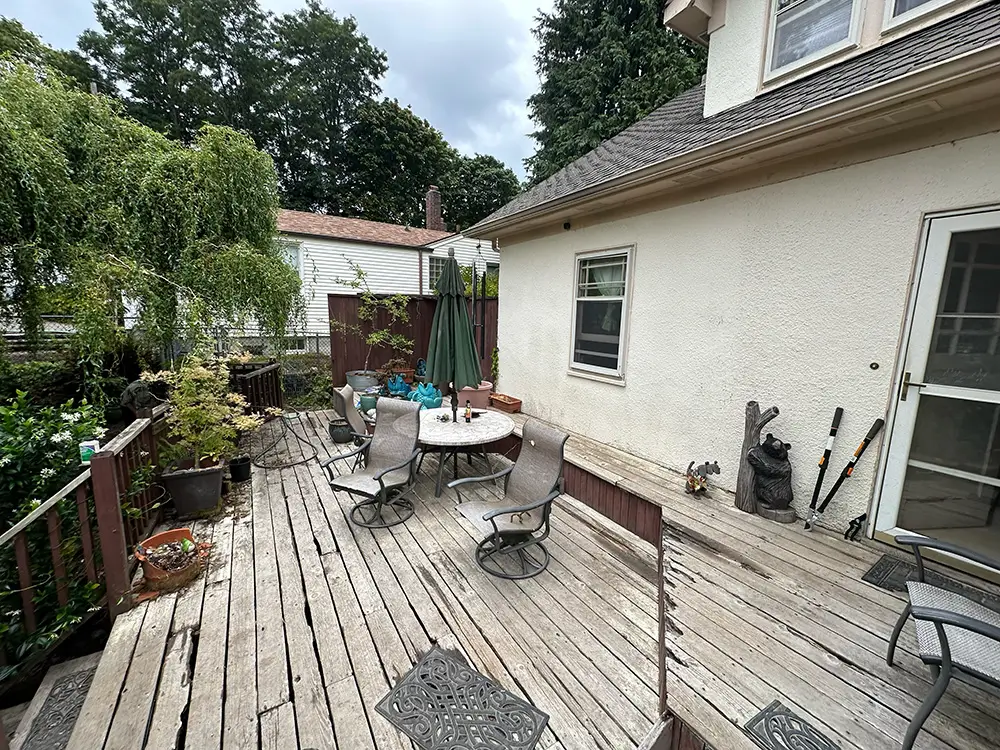
I get a call about once a week from a Tacoma homeowner who just noticed something off about their deck. A board feels soft. A railing wobbles a little more than last summer. There’s a gap forming where the deck meets the house. Most of these calls end with me reassuring them it’s fine for now, and they should put it on the maintenance list for spring. A few end with me telling them to keep their family off the deck until I can come look at it that week.
The hard part is that you can’t tell which one you have just by feeling uneasy. So this post is a checklist I walk homeowners through over the phone. Seven things to look at, what each one means, and whether it’s a “schedule it” problem or a “stop using the deck right now” problem.
I’m Daniel. I run Decks Restore, and we’ve been repairing and rebuilding decks across Tacoma, Federal Way, Gig Harbor, Puyallup, and the rest of the South Sound for over ten years. Washington State LIC# CC DECKSRL797P2.
You don’t need to be handy to do this inspection. You need a flashlight, maybe a screwdriver, and twenty minutes.
Decks fail mostly because of water. Tacoma gets about 38 inches of rain a year, concentrated in the wet months from October to May. Every winter we get freeze-thaw cycles that pry decks apart at the joints and connections. Every summer the wood dries out and shrinks, opening up new pathways for the next winter’s water.
A deck built in Phoenix can be ignored for fifteen years and still be safe. A deck built in Tacoma that nobody inspects? I’ve pulled boards off ten-year-old decks here and found joists you could push a screwdriver through. The wood looked fine on top.
The Consumer Product Safety Commission estimates that roughly 30% of US decks are past their safe service life or were built with materials no longer permitted by code. (CPSC Deck Safety). I think the percentage is higher in our region. Wet climates are harder on decks than the national averages account for.
So here’s the checklist. Start at the house side and work your way around.
This is the single most important thing to check. Ledger failure is what causes catastrophic deck collapses. When you read about a deck “pulling away from the house” and a family ending up in the ER, almost always it was the ledger.
Stand on the deck near the house. Look at the line where the deck meets the siding. You’re looking for:
Then go underneath if you can. Look at the bolts holding the ledger to the house. They should be lag screws or through-bolts, not nails. There should be visible flashing (a metal Z-shape) tucked behind the siding and over the top of the ledger. If you see nails, no flashing, or rotted wood, you have a serious problem.
What it means: Anything wrong here is a stop-using-the-deck problem. Not a schedule-it-for-spring problem. The ledger is what holds the deck to your house, and when it goes, the entire deck goes with whoever is standing on it. Get a licensed contractor out the same week.
Walk around the perimeter of the deck and look at every post that touches the ground. In Tacoma, posts rot from the bottom up. The damage is usually invisible until you push on the post.
Take a screwdriver. Press the tip into each post about two inches above grade and again right at the soil line. Healthy wood resists. Rotted wood lets the screwdriver sink in like cardboard.
Also check whether each post sits on a concrete footing or a metal post base, or whether it’s just buried in the dirt. Posts buried directly in the ground will rot. They might last 8 years, they might last 25, but they’ll rot eventually. Posts on proper footings with metal post bases (separating wood from soil) can last the life of the deck.
While you’re down there, look for posts that have shifted out of plumb (use a level if you have one), footings that have cracked or settled, soil washing away from the base of any footing, and concrete that’s flaking or spalling at the post base.
What it means: Soft posts are a same-week call. The deck’s weight is sitting on them and a single rotted post can cause a section to drop or the whole deck to lean. Cosmetic concrete cracking on a footing is usually fine. Settled or shifted footings are not.
If you can crawl or duck under your deck, do it. Bring the flashlight. This is where most of the damage hides.
You’re checking joists for sagging, splits along the grain, rot at the cut ends where the joists rest on the beam or in joist hangers, hangers that are rusted or pulling away from the wood, and water staining or fungus on the underside of the deck boards above. Press the screwdriver into a few joists, particularly at the cut ends. Cut ends are where pressure-treated lumber loses most of its protection, so they rot first.
If your deck has a beam (a doubled-up or tripled-up piece of lumber that the joists rest on), check that beam end-to-end. Beams hold up the joists. Joists hold up the boards. Boards hold up your kids. The whole stack matters.
What it means: A few minor splits along the grain are usually cosmetic. Sagging joists, soft cut ends, rusted hangers, or any fungus growth means the substructure is failing and you need a professional inspection. Don’t wait.
Walk every square foot of the deck. Pay attention to how each step feels. A deck board should feel solid. If it flexes, sponges, or sounds hollow when you walk on it, something is wrong with either the board or the joist beneath it.
Specifically look for:
Tap suspect boards with the handle of the screwdriver. Solid wood gives a sharp tap. Rotted wood gives a dull thud.
What it means: Individual board damage is usually a repair, not a replacement. The exception is when board damage points to a bigger problem, like systemic rot from water that isn’t draining properly, or boards failing because the joists below have failed. One bad board, fix it. Many bad boards in the same area, get an inspection.
Grab the top rail at multiple points along the deck. Push and pull on it. A safe railing has almost no give. A railing that wobbles, leans, or shifts more than maybe a quarter inch is failing.
Then look at the connection points: where the railing post meets the deck framing (under the deck, this is where a 4×4 should bolt through to a joist or a rim board), where the balusters meet the top and bottom rails, and where the top rail attaches to the posts. Stair railings get the most use and fail first. Pay extra attention to them.
The code requirement is that a deck railing has to resist 200 pounds of horizontal force at any point. That’s roughly the force of an adult falling against it. If your railing flexes when you lean on it, it would not stop a fall.
What it means: Any wobble in a railing is a real safety issue. Not a cosmetic one. Most railing problems trace back to how the post was attached to the deck framing originally. Sometimes a few new bolts and a structural connector fix it. Sometimes the rim board itself is rotted and the whole connection has to be rebuilt.
Stairs cause more deck injuries than any other component, and stringers (the diagonal supports running along the sides of the staircase) are usually what fails first in our climate. They typically run from the deck down to a concrete pad or directly into the dirt, and the bottom end stays wet for months at a time. That’s the spot to focus on.
Walk up and down your stairs slowly. Check for treads that flex or feel soft, risers that have separated from the treads, stringers that are split or rotted (especially at the base), inconsistent rise heights between steps, and loose handrails. Push the screwdriver into the bottom 12 inches of each stringer.
What it means: Soft stringers are a stop-using-the-stairs problem. A failed stringer can collapse under one person’s weight. Loose treads or handrails are scheduled repairs unless they’re severe enough to make the stairs unusable.
Last check, and the one most people skip. After the next rain, go look at your deck while it’s still wet.
Where does the water go? It should sheet off the surface and away from the house. It should not pool on the deck surface. It should not pool around posts or footings. It should not run toward the house and pool against the siding. It should not stay wet in the same spots for days after the rain stops. And it should not drip continuously off the underside (water should drain quickly, not seep).
Standing water is what kills decks in Tacoma. If you have ponding spots that stay wet through the wet season, you’re effectively giving your deck a five-month bath every year.
Also check the grade around your deck. Soil should slope away from any post or footing, not toward it. If the ground around your deck has settled or built up over the years to where water now runs toward the structure, that’s accelerating your deck’s decline whether you can see the damage yet or not.
What it means: Drainage is the slowest-killing of the seven items on this list. It’s also the cheapest to ignore and the most expensive to fix later. If you spot ponding or slope issues, get them addressed in the next dry season, even if the deck still looks fine on top.
Walk through the seven items in order. If everything checks out, congratulations, you have a safe deck. Schedule a re-inspection for the same time next year, and read up on seasonal deck maintenance for Tacoma homes to keep it that way.
If you found issues in items 4, 5, or 7 (boards, railings, drainage), you probably have a scheduled deck repair project ahead of you. Get two or three quotes from licensed Washington contractors. Ask about each contractor’s WA L&I license number and verify it before signing anything.
If you found issues in items 1, 2, 3, or 6 (ledger, posts, joists, stairs), stop using the affected area of the deck and call a contractor that week. Ledger and post failures can collapse a deck in seconds. Most of the worst injuries happen when people knew something was wrong but kept using it anyway.
We do free deck inspections across Tacoma and the South Sound. If you’re not sure what you found, send a few photos to (253) 677-0290 and I’ll tell you whether it can wait or whether we need to get out there.
How often should I inspect my deck in Tacoma? Once a year, in early spring before you start using the deck for the season. The wet season does most of the damage, and a spring inspection catches problems before summer use stresses them further. After any major windstorm or unusually heavy snow load, do a quick walkthrough of items 1, 2, and 5 even if you inspected recently.
Is it safe to walk on a deck with a soft board? A single soft board is usually safe to walk around but should be replaced soon. The bigger question is why the board went soft. If it’s at a cut end where water pools, that’s localized. If it’s in the middle of a board with no obvious cause, the joist beneath has likely failed and the rot is moving. Stay off that section until someone looks at it.
My deck wobbles a little when several people walk on it. Is that normal? Some flex is normal on long unsupported spans. A deck that bounces visibly under one person, or shakes when someone walks across it, is not. Bounce usually means undersized joists or joists that have lost stiffness due to rot. Get it looked at.
How long does a deck last in Tacoma? Depends entirely on how it was built and how it’s been maintained. A pressure-treated wood deck built right with proper flashing, drainage, and post bases can last 20 to 30 years. The same deck built badly or ignored for maintenance can fail in 8 to 12. We have a longer post on wood deck lifespan in Tacoma if you want the detail.
Can I do these inspection items myself, or do I need a professional? You can do all seven yourself. The point of this checklist is to catch problems early, not to replace a professional inspection. If anything you find concerns you, or if you’re not sure how to evaluate what you’re seeing, call a licensed deck contractor. Most of us, including us, do free assessments.
What’s the difference between a deck repair and a deck rebuild? Repair means fixing specific failed components on a deck whose substructure is sound. New boards, a fixed railing, a sistered joist, a replaced stringer. Rebuild means the substructure itself has failed and we’re replacing the framing, often keeping the existing footings if they’re good. Repair runs $500 to $5,000 typically. Full rebuild runs $30 to $60 per square foot.
Are deck inspections required in Tacoma? For residential decks, no. The City of Tacoma inspects decks at the time of construction (when permitted) but doesn’t require periodic inspections after that. Some HOAs and rental properties have their own requirements.
What does a professional deck inspection cost? Most licensed deck contractors here offer free inspections as part of a quote process, especially if you’re considering repair work. Standalone home inspections that include a deck typically run $300 to $600. Ours are free.
If anything in this checklist worried you, or if you’d rather have someone with experience look at your deck before something happens, we’ll come out and do a free assessment. We’ll tell you straight what’s wrong, what’s fine, and what it would cost to fix.
Call: (253) 677-0290 Or request a free quote online.
We serve Tacoma, Gig Harbor, Federal Way, Puyallup, Auburn, Kent, Renton, Bellevue, Seattle, and the rest of the South Sound. Decks Restore, Washington State LIC# CC DECKSRL797P2.
Daniel is the owner of Decks Restore. He’s overseen deck inspections, repairs, and rebuilds across Tacoma and Pierce County for over a decade and holds Washington State Contractor License CC DECKSRL797P2. Every quote and project at Decks Restore goes through him before it reaches the customer.