 Customer Service: (253) 677-0290
 Customer Service: (253) 677-0290
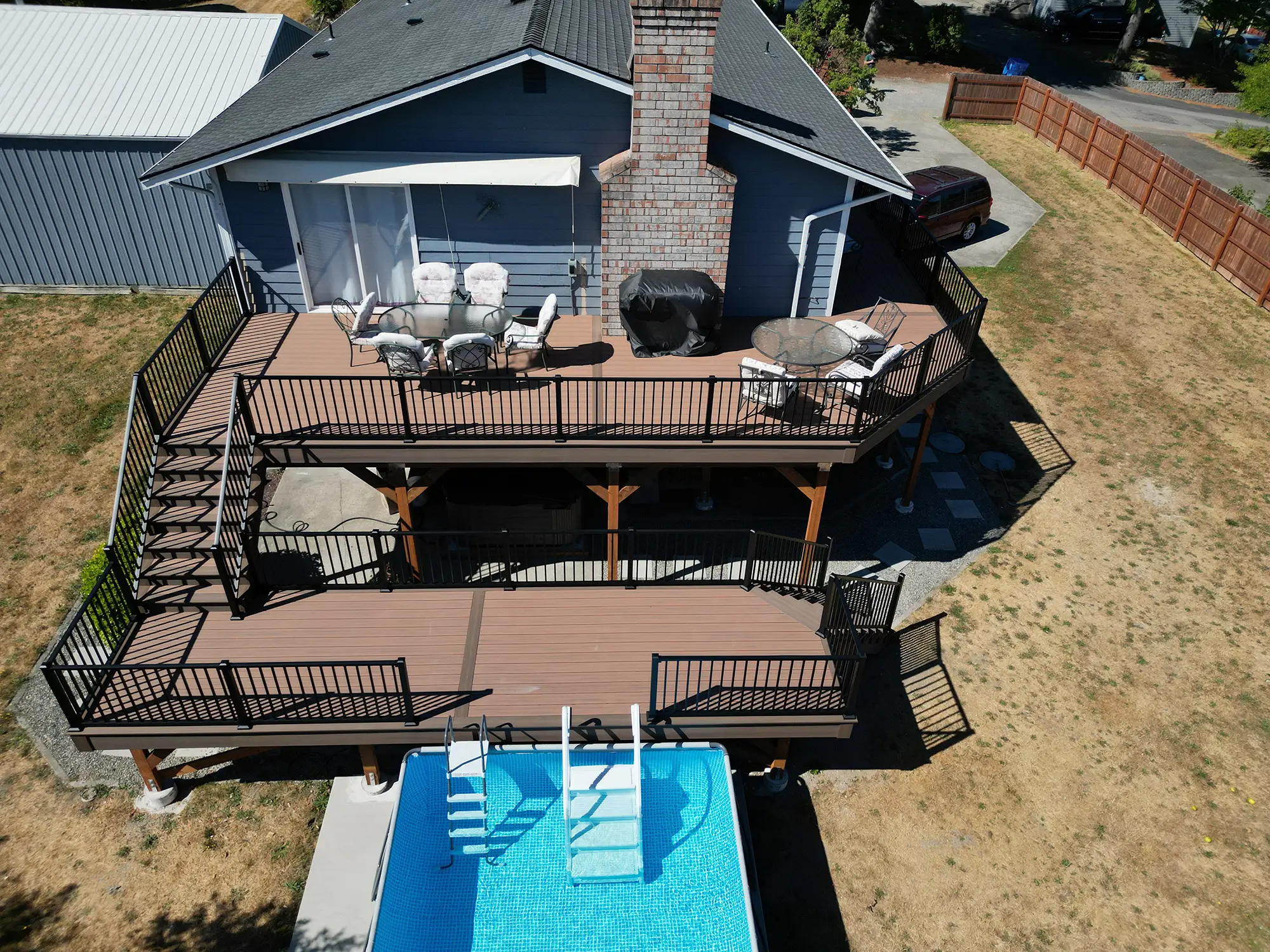
By Daniel Rotaru, Owner and CEO at Decks Restore WA Contractor License # CC DECKSRL797P2
Every spring I get the same call. Sometimes three or four in a single week. A Tacoma homeowner finally gets a dry weekend after six months of clouds, drags the pressure washer out of the garage, hits the deck, and panics halfway through. The boards look worse than when they started. Fuzzy along the grain. Streaked in patches. In a few cases the surface is visibly torn open and the wood underneath looks like raw hair.
Then I get the call. “Daniel, what did I do?”
The answer is almost always the same one. Too much pressure, way too close, wrong tip, wrong direction, on a board that was never built to take that kind of beating. I have watched homeowners destroy a five year old deck in twenty minutes. I have also watched experienced pros do it, which is the part nobody likes to talk about. Pressure washing a wood or composite deck in the Pacific Northwest is one of the most common ways a perfectly good deck gets retired before its time.
This post is what I tell people when they ask me how to clean their deck this spring without making it worse.
A pressure washer was built to strip paint off concrete and blow silt out of grout lines. It is not a deck cleaning tool. The marketing industry decided to call it one, and homeowners reasonably assumed the labeling was accurate.
Here is what is physically happening when you point a 2,500 or 3,000 PSI wand at a softwood deck board. The water is hitting the wood at a speed that strips the soft summer growth out from between the harder winter growth rings. The summer growth is the lighter, more porous part of the grain. It is also the part that gives the board its smooth surface. Blast it out and you are left with what people call fuzzing. A furry, raised, fibrous surface where the softer wood used to be.
Once that fuzzy surface is there, a few things start happening that you cannot easily undo.
The deck immediately looks worse than it did before you started. The color is lighter, the surface is rougher, and the texture you used to walk on barefoot is gone. The next time it rains, which in Tacoma in April is most days, the fuzzy grain absorbs water at maybe three times the rate the smooth surface did. The wood swells, dries, swells, dries, and you accelerate the cupping and cracking that pressure washing was supposed to prevent. Then any stain or sealer you apply soaks into the damaged grain unevenly. You get the streaked, blotchy look that homeowners go on to blame on the stain.
I have walked onto cedar and pressure-treated decks where one weekend with a rental pressure washer took five years off the deck’s usable life. The boards still function. They look about a decade older than they actually are.
A lot of people assume composite is plastic, so it can handle anything. That is not quite right either.
Composite decking, meaning Trex, TimberTech PRO, Fiberon Concordia, and the rest of the wood-plastic hybrid lines, has a cap on the outside that protects a wood-plastic core. That cap is what gives the board its fade resistance, mold resistance, and color. Strip the cap and the board underneath was never designed to be exposed.
A high-PSI wand at close range will absolutely peel that cap. I saw it happen on a four year old Trex Enhance deck in Federal Way. The homeowner thought he was being gentle. He had a 3,000 PSI machine sitting about eight inches off the deck on a 25 degree tip, and he ran it across the same area three times trying to get a stain out. By the third pass the cap was visibly thinned and the underlying wood-plastic was showing through. You cannot put cap back on a board. That deck has a permanent bald spot now and the homeowner has been living with it for three years.
PVC boards, like TimberTech AZEK and Fiberon Sanctuary, are tougher because they are polymer all the way through. They still scratch. They still gouge if you run a high pressure wand close enough, or if you put a turbo tip on by accident. I have not seen a stripped cap on a PVC board because there is no cap to strip, but I have seen plenty of gouging.
The manufacturers do allow pressure washing within specific limits. Trex’s official care and cleaning guide caps it at 3,100 PSI with a fan tip and an eight inch minimum distance. That is the ceiling, not the suggestion. Most homeowners I see in trouble are running a 2,800 PSI machine three or four inches off the surface with whatever tip happens to be screwed on, and they are surprised when the cap comes off. The math was working against them the whole time.
Our climate makes everything I just described worse.
We have moss. Real moss. Not a little surface green that you can wipe off with a sponge, actual moss colonies that have put root structures down into the grain of softwood and into the texture of composite. Homeowners look at that moss in March and they reach for the most aggressive tool they own because the moss looks like it deserves it.
We have eight months a year of damp. Boards that have been holding moisture all winter are softer in April than they will be in August. Hit a board in April with a wand setting that would be fine in midsummer and you will do more damage on the same job. People do not think about this. The deck just feels like the deck.
And we have a lot of overhanging trees. The Tacoma canopy is part of why we love this city, but it also means most of our decks are sitting under constant organic debris. Needles, sap, leaf tannin, bird droppings. Owners watch staining accumulate all winter, panic in spring, and over-correct with the strongest tool they have. I have walked decks in Gig Harbor, Federal Way, the North End, and Renton where the pressure-washing damage maps exactly to the spots where a tree drops its load each fall. The owner attacked the staining hardest right where the wood is also softest from being wet the longest. That is the worst possible combination.
The right way to clean a deck in the Pacific Northwest does not start with a pressure washer at all. Here is the order I give my clients.
Sweep first. Push broom, vigorous, get the loose debris off the surface before water touches anything. A lot of what people call staining isn’t really stain. It is debris that hasn’t been swept yet.
Then rinse with a garden hose on a fan nozzle. Not a pressure washer. A regular garden hose. You are loosening dirt, not stripping the board.
Now mix a cleaner that actually fits the deck. For composite, warm water and dish soap, or a composite-specific cleaner from the manufacturer’s approved list. For wood, an oxygen-based deck cleaner (sodium percarbonate) is what I use on my own jobs. Skip chlorine bleach on wood, because it strips lignin and lightens the wood unevenly, and skip it on composite too, because the major manufacturers explicitly flag it as a warranty issue.
Apply the cleaner with a soft-bristle deck brush on a long handle. This is the actual work of the job. Scrub in the direction of the grain. Let the cleaner sit for whatever the label says, usually ten to fifteen minutes, and don’t let it dry on the surface.
Rinse thoroughly with the hose. Take longer than you think you need to. Any cleaner left on the deck dries to a film and that film will haunt you in stripes the first time the sun comes out.
If, and only if, the soft method couldn’t get to a particular moss patch or stubborn stain, you can use a pressure washer at the manufacturer’s actual specified maximum. For most composite that means about 1,500 PSI with a fan tip, twelve inches off the surface, moving the wand at a steady pace along the grain. For pressure-treated wood I cap myself at 1,200 PSI. For cedar I do not use a pressure washer at all. I use the brush.
This protocol takes longer than a pressure washer would. It does not take longer than fixing pressure washer damage takes, which is usually some combination of sanding, board replacement, and a refinish job that should not have been necessary.
Putting stain or sealer on wet wood is one of them. After a real cleaning, a deck needs at least 48 hours of actually dry weather, not “overcast and not raining right now,” before any finish goes on. In Tacoma that often means waiting weeks for a proper window in April or May. Skipping the wait is why so many decks have stain peeling six months later, and then the homeowner blames the stain brand instead of the timing.
Spraying bleach to kill moss on a composite deck is another one. Someone reads a forum thread, mixes bleach in a garden sprayer, and walks it across their Trex or Fiberon deck. The bleach lightens the cap unevenly. Now the deck has streaks the homeowner cannot get rid of, and the manufacturer warranty almost certainly is not going to cover what happens next. I get a call about this once or twice every spring.
A third one is wire brushes. I should not have to mention this and yet every year I see at least one deck with the parallel gouge lines from a wire brush someone used on a moss spot. Soft bristle. Always. Even on the worst staining you have ever seen on your own deck. If a soft brush will not get it, a wire brush is going to carve grooves into the board that hold water and dirt for the rest of the deck’s life. You will have traded a cosmetic problem for a structural one.
And one more. Do not sand a composite deck. Trex tells you not to in writing. Sanding takes the cap off, and once the cap is gone the board is exposed to UV and moisture in ways the manufacturer never tested. The deck will not fail next week. It will age noticeably faster than it should from that day forward.
Sometimes a deck genuinely is past where soap and a brush will save it. The grain has lifted. The color has gone uneven gray. Boards are checking. That is not a cleaning problem anymore.
On a wood deck, that usually means a proper sand and recoat, or, if the boards are too far gone, board replacement on the existing frame. On a composite deck with cap damage, board replacement is really the only honest fix, because the underlying core was never designed to be the visible surface.
If you are looking at your deck this spring and you cannot tell whether it is a cleaning job or a bigger one, give us a call. I personally walk every Tacoma project before we quote it. You can read about what we do on our services overview, look through completed projects in our gallery, or check out deck resurfacing if your frame is sound but your boards are tired. If you are searching for deck builders near me in Tacoma, our Tacoma deck builder page covers exactly how we work in this part of the South Sound.
When you are ready, call (253) 677-0290 or request a free estimate. Every quote at Decks Restore goes through me personally before it reaches the customer.
Clean your deck gently this spring and it will probably outlast the neighbors’ decks by a decade. Hit it with a 3,000 PSI wand and you have just signed yourself up for a much bigger job in two or three years.
About the author. Daniel Rotaru is the owner and CEO of Decks Restore LLC, a fully licensed, bonded, and insured deck builder serving Tacoma, Federal Way, Gig Harbor, Renton, Puyallup, Auburn, Kent, and the surrounding Puget Sound area. Washington Contractor License # CC DECKSRL797P2. Daniel personally walks every project at quote and at final inspection.