 Customer Service: (253) 677-0290
 Customer Service: (253) 677-0290
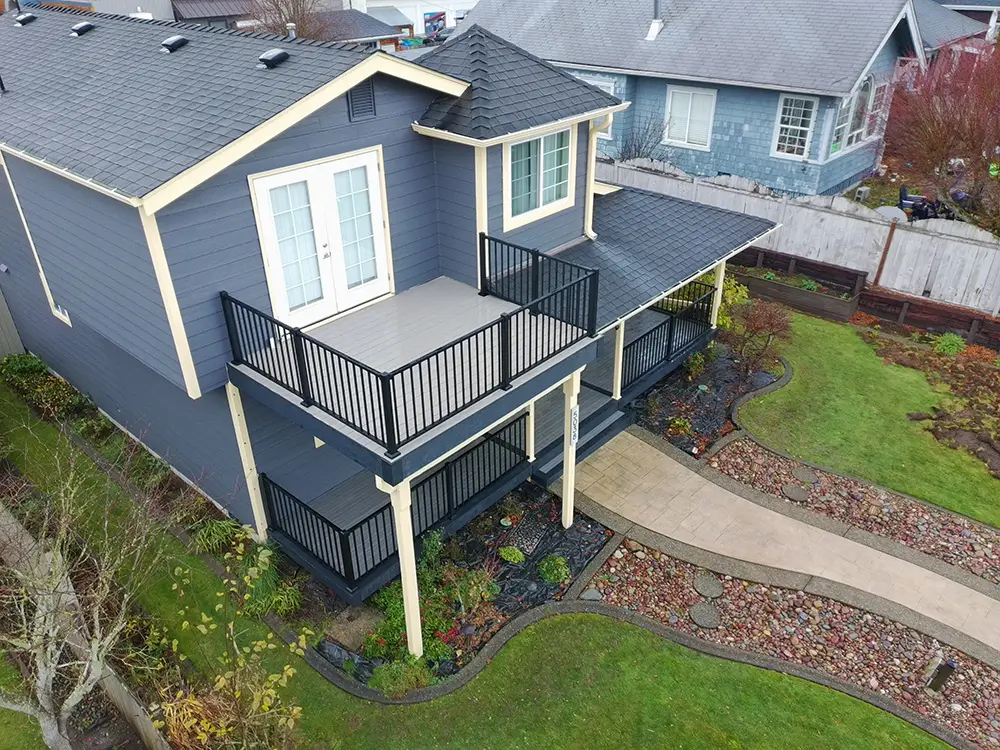
If you live within a mile of the water in Tacoma, the deck you build is going to fight a war the rest of Pierce County never has to think about. Salt air, fog, and 38 inches of rain a year work on every fastener, joist hanger, and board you put down. Materials your neighbor used four miles inland will start failing on your house in five to seven years.
We’ve torn out a lot of those decks. Browns Point. Salmon Beach. Point Ruston. Dash Point. Old Town. The story is usually the same one: a homeowner hired a builder who didn’t think about salt, and the deck looked fine until the structure underneath was already gone.
This is what we wish every Tacoma waterfront homeowner knew before they signed a contract.
Plain rain is bad for wood. Wet wood, drying, getting wet again is how rot starts. But salt-laden air carries chloride ions that get into every metal connection in your deck, accelerate corrosion, and pit the surfaces of fasteners until they fail.
A galvanized joist hanger inland might last 30 years. The same hanger 800 feet from the water at Browns Point fails in 8 to 12. We’ve pulled hangers off houses where the zinc coating was completely gone and the underlying steel was crumbling like old paper. The deck looked solid from the top. The structure underneath was at maybe 40% of its original strength.
The other thing salt does, which most homeowners don’t think about, is shorten the life of the wood itself. Salt is hygroscopic. It pulls moisture out of the air and holds it against the wood, so even on a dry sunny day, salt-coated boards stay damp longer than they should. That’s why pressure-treated decks on the waterfront cup, check, and split years sooner than the same boards do in Puyallup or Auburn.
Forget board choice for a minute. The single most important decision on a salt-air deck is the hardware.
Three grades you need to know about:
Hot-dipped galvanized (G185 or better). Fine for inland Tacoma. Acceptable for the South Hill, Lakewood, parts of the East Side. Not acceptable within roughly half a mile of saltwater. The zinc coating is sacrificial. It corrodes first to protect the steel, and salt air burns through it.
Stainless steel 304. A step up. Some Tacoma builders use 304 on waterfront jobs and call it good. It’s better than galvanized, but it isn’t enough. 304 will pit and stain in chloride exposure, and over 15 to 20 years it will fail.
Stainless steel 316 (marine grade). This is the right answer for any deck within sight of saltwater. 316 has 2 to 3% molybdenum added to the alloy, which is what gives it real resistance to chloride pitting. It costs more, sometimes 3x what galvanized does, and it’s worth every dollar. We use 316 for fasteners, joist hangers, post bases, and ledger lag bolts on every waterfront build.
If you’re getting quotes from Tacoma deck builders and one of them tells you their galvanized hardware “should be fine for saltwater,” that’s where you stop the conversation. They either don’t know or they’re hoping you don’t.
Pressure-treated pine is a bad choice for a waterfront Tacoma deck. It will work for a few years. It will look terrible by year seven. We don’t recommend it for any deck within a mile of the Sound, and we’ll usually try to talk you out of it.
That leaves the decisions that actually matter.
Ipe is a Brazilian hardwood that’s so dense it sinks in water. It shrugs off salt, moisture, and UV better than any natural material we install. A properly built Ipe deck on Salmon Beach should give you 30 to 40 years of service with nothing more than an annual oil application if you want to keep the color. If you don’t oil it, it weathers to a soft gray, which a lot of homeowners prefer anyway.
Downsides: it’s expensive, it’s heavy, and it requires pre-drilling every fastener, which is why your build labor goes up. But if you want a deck that becomes a generational asset on a waterfront house, Ipe is the answer.
PVC decking, like Azek and Wolf, is solid plastic. Not a wood and plastic mix. It doesn’t absorb water at all, doesn’t feed mold, doesn’t care about salt. For homeowners who want low maintenance and long life on the waterfront, PVC is our second pick after Ipe.
The catch: PVC gets hotter than composite in direct sun. On a south facing Point Ruston deck on a 90-degree July afternoon, you will not walk barefoot. Plan your shade or pick lighter colors.
Here is the thing nobody tells you. Most premium composites — Trex Transcend, TimberTech AZEK, MoistureShield Vision — are rated for marine environments and work fine on a Tacoma waterfront deck. Composite has a polymer cap that resists moisture and chemical attack. The cap doesn’t care about salt.
But the screws and joist hangers underneath the composite still do. We’ve been called to inspect Trex decks on the waterfront where the boards looked brand new and the framing was rotting through because the original builder used composite-rated screws but galvanized framing hardware. The composite manufacturer’s warranty doesn’t cover your structure. It only covers the boards.
If you go composite on a waterfront Tacoma build, the boards will probably outlast the structure unless your builder uses 316 stainless on everything below them. Most Tacoma builders don’t.
Cedar is a Pacific Northwest classic and we like working with it. It has natural rot resistance and it weathers well. But on the immediate waterfront, cedar is a 12 to 15 year deck, not a 25 year deck. The salt accelerates the silvering and the soft summerwood rings get pitted. If you’re a cedar person and you’re on the waterfront, we’ll build it for you, but we’ll have the honest conversation first about lifespan.
Tacoma’s waterfront soil is mostly heavy glacial clay with pockets of sand and fill. That clay has two relevant properties: it holds water, and it shrinks and swells with seasonal moisture changes.
What that means for a deck: a footing dug to the wrong depth, or set without proper drainage, will heave in the winter and settle in the summer. Over five years, your deck twists. We’ve seen waterfront decks where one corner rose three quarters of an inch and the railing pulled away from the house.
The fix isn’t complicated, but it has to be done. Footings on Tacoma waterfront properties should be dug below the local frost line (18 to 24 inches in most of Pierce County, deeper if you’re up the bluff in Browns Point or Dash Point), set on at least 6 inches of compacted gravel for drainage, and tied to engineered post bases. Not toenailed 2x6s.
If a builder quotes you a waterfront deck and the footing detail in the proposal says “concrete piers,” ask what depth and what the diameter is. If they shrug, that’s another walk-away conversation.
The City of Tacoma has a Shoreline Master Program that applies to any property within 200 feet of the ordinary high water mark. If you live on the water — Old Town, Ruston, parts of Salmon Beach — your deck project may require a Shoreline Substantial Development Permit in addition to the standard building permit.
This catches a lot of homeowners off guard. The shoreline permit can take 60 to 120 days to process. The rules around impervious surface coverage, setback from the bluff, and tree retention are stricter than the standard residential code. We handle this for our waterfront clients, but it’s worth knowing about because it changes your project timeline by months, not weeks.
Outside the 200-foot shoreline zone, the standard Tacoma building permit applies. We pull every permit on every job. If a builder offers to skip the permit to save you a few hundred dollars, that’s the third walk-away conversation in this article. The city will catch it when you sell, and an unpermitted deck on a waterfront property tanks your appraisal.
If you’re searching for deck builders in Tacoma and you live near the water, the questions you ask matter more than the price you compare. Three things we’d put on your list:
What hardware grade do you spec for waterfront jobs? You want to hear “316 stainless” without hesitation.
What’s your footing detail for clay soils? You want to hear depth, gravel base, and engineered post bases.
Have you pulled a Shoreline Substantial Development Permit before? If yes, ask which job and call the homeowner.
We’ve built and rebuilt enough waterfront decks in Tacoma to know what fails and why. If you’re planning a project on the Sound and want a free walk through and an honest assessment of what your situation actually needs, we’re at 748 Market St #173, Tacoma, WA 98402. Call (253) 677-0290 or reach out through the Tacoma deck builders page.
The water is going to do what it’s going to do. The deck either accounts for it or it doesn’t.
Related reading: What Is the Lifespan of a Wood Deck in Tacoma? · Permits and Regulations for Deck Construction in Tacoma