 Customer Service: (253) 677-0290
 Customer Service: (253) 677-0290
By Daniel Rotaru, Owner and CEO at Decks Restore. WA Contractor License # CC DECKSRL797P2.
The calls I dread are the ones that start with someone falling. A homeowner steps out onto a wet deck in October, the boards are slick with rain and a film of algae, their foot goes out from under them, and now they are asking me to fix a deck they have had for six years. It is avoidable. Most of the time the deck was just built or finished without any thought for how it behaves when it is soaked, which in Tacoma is most of the year.
We get something like forty inches of rain a year here, and our decks spend long stretches damp, shaded, and growing a thin layer of moss or algae that you can barely see until you are sitting on the ground. So when a homeowner asks me how to keep a deck from getting slippery, I treat it as a real safety question, not a finish preference. Here is what actually works, what helps a little, and what does almost nothing.
Two things make a deck slick, and they stack on top of each other. The first is plain water sitting on a smooth surface. The second, and the one people underestimate, is the biological film that grows on a damp deck in our climate. Algae, moss, and mildew form a slimy layer that is far more slippery than clean wet wood. A board that feels fine in July can be treacherous in November because of what has grown on it, not just because it is wet.
That is why slip resistance is not a one-time decision you make at install and forget. The surface you choose matters, but so does keeping that surface clean. The grippiest board in the world turns slick if you let a season of algae build up on it.
Traction comes down to texture. A smooth, sealed surface sheds your footing when it is wet. A surface with grip gives your shoe something to bite into and gives the water somewhere to go instead of forming a film under your foot. Here are the approaches I use, roughly in order of how well they hold up in our weather.
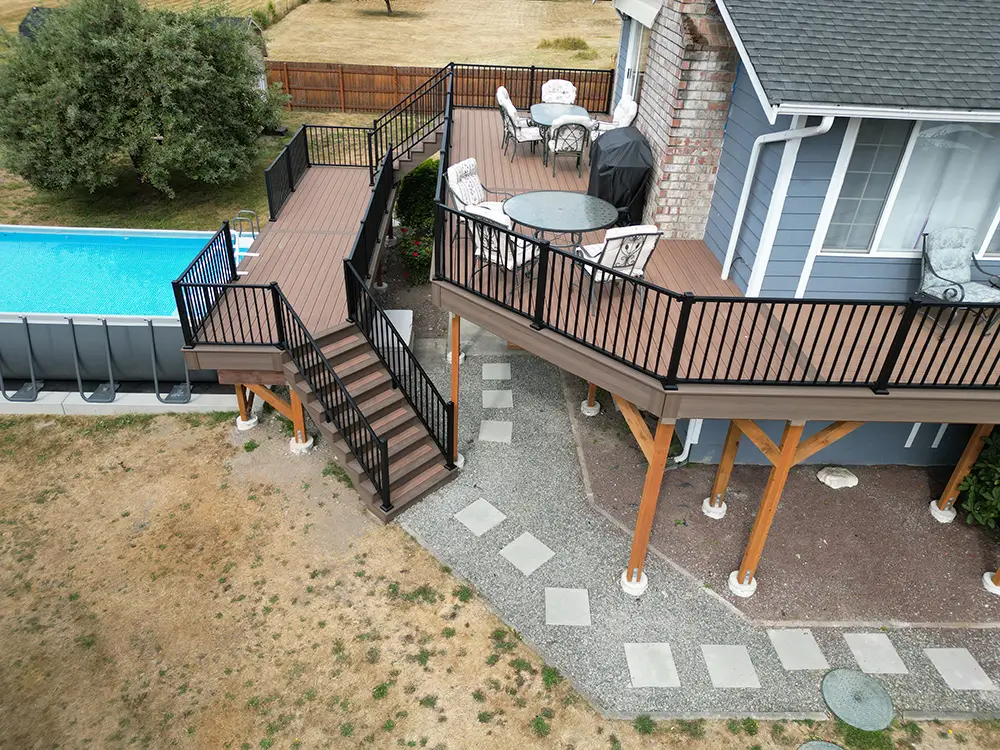
Grooved or embossed composite boards. Most quality composite lines come with a textured or wood-grain surface that holds traction when wet far better than a smooth board. Some are made with the slippery side and a more aggressive grain on the reverse, so you can install the grippier face up. This is usually my first recommendation for a Tacoma deck, because it builds the slip resistance into the board itself and does not wear off. It is one more reason I often steer homeowners toward composite in our climate.
Grit-embedded or anti-slip strips. For stairs and high-traffic paths, you can add strips with an abrasive grit surface, similar to skateboard tape but built for outdoor use. These are not pretty, and I am honest with people about that. But on a set of wet stairs, which is where most serious deck falls happen, they are worth the look. I would rather a homeowner have safe stairs than a beautiful one that sends someone to the emergency room.
Grooved wood and traction finishes. On a wood deck you can have the boards grooved, or apply a finish with a fine grit additive mixed into it. The grit finishes do help. The honest limitation is that they wear down where people walk most, which is exactly where you need them, so they need reapplying over time. On wood I still think there are real reasons to choose it, and I have written about the case for a wood deck elsewhere, but you have to accept the upkeep that comes with keeping it grippy.
| Approach | How well it works wet | The honest trade-off |
|---|---|---|
| Textured composite boards | Strong, built into the board | Higher upfront cost than wood |
| Grit strips on stairs and paths | Very strong where it counts | Not the best looking |
| Grit-additive finish on wood | Helps noticeably | Wears in traffic, needs reapplying |
| Slick sealer with no texture | Makes things worse when wet | Avoid on a rainy-climate deck |
A lot of slippery decks in Tacoma got that way because someone put a glossy, film-forming sealer on a smooth board. It looks great the day it goes down. Then it rains, and that smooth glossy film is exactly the surface water loves to sit on. If you are sealing a wood deck in our climate, you want a penetrating finish with some traction to it, not a high-gloss coat that sits on top like a layer of plastic. I have stripped plenty of decks where the slip problem was entirely the finish, not the wood.
If you want to get technical, slip resistance is measured by something called the coefficient of friction, and a wet reading of around 0.42 or higher is the common benchmark for a surface meant to be walked on when wet. One thing worth knowing is that there is no slip standard written specifically for decking. Decking falls under the same flooring standards as tile, so when a board manufacturer publishes a wet traction number, that is the scale they are using. The U.S. government’s facilities research office has a clear plain-language overview of how slip resistance is measured if you want to understand the ratings before you shop. You do not need to memorize any of this. But if a salesperson cannot tell you anything about how a board performs wet, that tells you something too.
None of this lasts if the deck is filthy. The single biggest thing a Tacoma homeowner can do for traction is keep the surface clear of the algae and moss film that builds up in the wet months. A gentle wash a couple of times a year, especially heading into fall, removes the slick biological layer before it becomes a hazard. Skip the pressure washer set on high, which can chew up wood and even some composite surfaces and leave them rougher in a bad way. A soft wash and the right cleaner is all most decks need.
For a deck in our climate, build the traction into the surface from the start. Textured composite for the main field, grit strips on the stairs, and a penetrating finish rather than a glossy one if you are going with wood. Then keep it clean. Do that and a wet Tacoma deck stays safe to walk on through the whole gray stretch of the year, not just in summer. If you would rather have it handled right from the framing up, that is what our Tacoma deck building team does on every job.
Worried about a slick deck, or planning a new build you want safe in the rain? I will come look at your deck, tell you honestly whether it is a cleaning issue or a surface issue, and give you a written plan. No salespeople, no subcontracted crews. Request a Free On-Site Estimate
About the author. Daniel Rotaru is the owner and CEO of Decks Restore, a licensed and insured Washington State deck builder (WA LIC # CC DECKSRL797P2) serving Tacoma, Gig Harbor, Federal Way, Puyallup, and the wider South Sound. He has spent his career building custom wood and composite decks engineered for the wet Pacific Northwest climate, with a focus on decks that stay safe and usable year round.