 Customer Service: (253) 677-0290
 Customer Service: (253) 677-0290
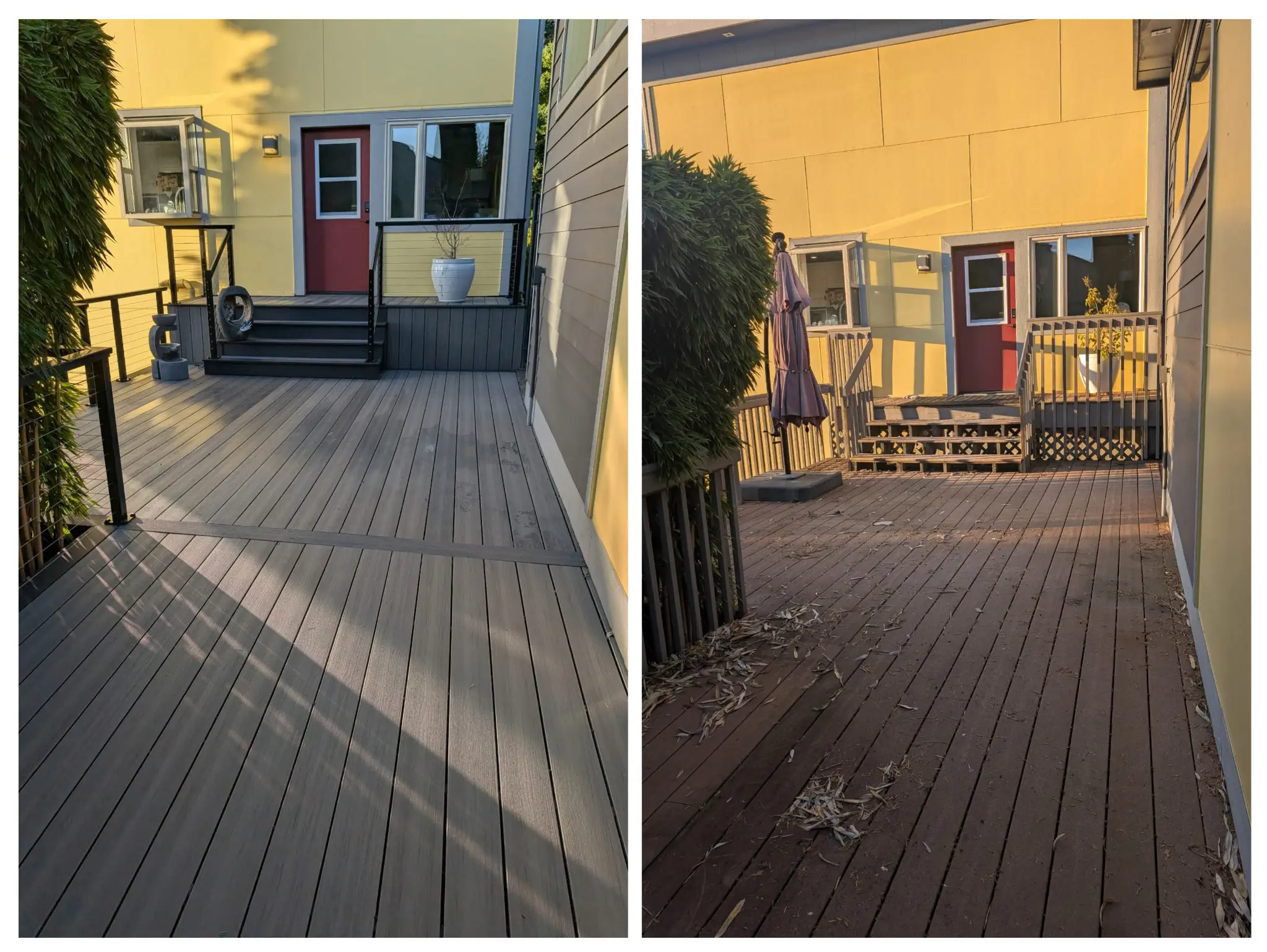
Most pool decks I see in Tacoma don’t need to be replaced. They need to be resurfaced. The slab underneath is usually fine. It’s the surface on top that’s cracked or faded or gone slick when it rains.
I’m Daniel. I run Decks Restore. We’ve been resurfacing pool decks across Tacoma, Gig Harbor, Federal Way, Puyallup, and the rest of the South Sound for over ten years. This is the same conversation I have with homeowners who call us out for a free assessment, written down so you can read it before you call.
Resurfacing is when we keep your existing concrete slab and put a new finished surface on top of it. The new surface can be a thin polymer-modified concrete overlay, a layer of porcelain pavers, travertine tiles, or a textured decorative coating.
What we don’t do is remove the old slab, repour, or dig new footings. That’s full pool deck replacement, and it’s a much bigger job.
Resurfacing only works if the slab underneath is structurally sound. Hairline cracks, surface flaking, faded color, an outdated look. All fine. Slabs that have heaved, settled more than an inch, or cracked all the way through usually need replacement instead. I’ll tell you which one you have when I come out.
Pricing settled down in 2026 after a few weird years for materials. Here’s what to budget for, in installed cost per square foot, on a typical 400 to 800 sq ft pool deck:
| Resurfacing option | 2026 cost per sq ft | Typical 600 sq ft total |
|---|---|---|
| Polymer-modified concrete overlay (textured, slip-resistant) | $8 to $15 | $4,800 to $9,000 |
| Stamped or decorative concrete coating | $12 to $20 | $7,200 to $12,000 |
| Spray-knockdown texture (cool-deck style) | $9 to $14 | $5,400 to $8,400 |
| Porcelain pavers (over existing slab) | $18 to $28 | $10,800 to $16,800 |
| Travertine tile overlay | $20 to $32 | $12,000 to $19,200 |
| Full pool deck replacement (for comparison) | $35 to $60+ | $21,000 to $36,000+ |
These prices include surface prep, materials, labor, sealer where it applies, and cleanup. They don’t include drainage corrections, big crack repair, or coping replacement. If your deck needs those, I’ll quote them as separate line items so you can see exactly what’s adding to the price.
A few things move the price within these ranges. Square footage matters; bigger jobs see lower per-foot pricing. Access matters; a pool deck behind a narrow side gate costs more in labor than one you can drive a wheelbarrow up to. Substrate condition matters most. A slab that needs heavy grinding and crack repair takes a day longer to prep, and that day shows up in the quote.
If a contractor quotes you well below these numbers in 2026, ask what’s included in the prep. Cheap pool deck work almost always cuts corners on substrate prep, and substrate prep is what determines whether the surface lasts.
This is what most people pick. A thin cement-based overlay, troweled or sprayed on, finished with a slip-resistant texture in the color you choose. It bonds to existing concrete, flexes with seasonal expansion, and stays grippy when wet. You’ll want to re-seal it every three to five years. Lifespan is 15 to 25 years if you keep up the sealing.
This is the right answer for most homeowners.
Large-format porcelain pavers, usually 24″x24″ or 24″x48″, laid on a thin-set bed over the existing slab. Porcelain reads like natural stone but doesn’t absorb water, doesn’t grow moss, and never needs sealer. Lifespan is 30+ years.
It’s the best material for our climate, full stop. The only reason not to choose it is the price.
Natural travertine tile, tumbled or chiseled-edge. It’s gorgeous. Cool to the touch in summer. But it’s porous, which means it has to be sealed every year in Tacoma or it will stain.
I’m honest with people about this one. If you’ll commit to sealing it every spring, it’ll outlast almost everything else. If you’ll forget, pick porcelain instead. Lifespan is 25+ years if you actually do the maintenance, much less if you don’t.
A specialty acrylic or cement-based coating sprayed on, then lightly troweled to create a slip-resistant texture that stays cool underfoot. Designed specifically for pool surrounds. Lifespan is 12 to 18 years with periodic recoating.
Cool-deck coatings matter more in Phoenix than in Tacoma, because we don’t really have a barefoot-on-burning-concrete problem. But the slip resistance and the price point still make this a popular choice for people on tighter budgets.
This is where pool decks fail. Tacoma sits in one of the wettest urban climates in the country, roughly 38 inches of rain a year, mostly between October and May. If water can’t get off the deck and out from under the substrate, it pools at edges, soaks into joints, and freezes in winter. That cycle wrecks overlays, pops pavers, and stains travertine.
Before we put anything new down, I look at the slope of the deck. It should fall at least a quarter inch per foot away from the pool and the house. I check the existing expansion joints, because they need to keep working, not get filled in. I check the perimeter to see if water actually leaves the deck or just sits at the edge. And I check the house-side flashing, because if anything is getting in behind your siding where the deck meets the house, that’s a different and more expensive problem hiding under your project.
If we find drainage issues, I quote the fix as a line item. I’m not going to leave it out so the bid looks lower. I’d rather not take the job than do a resurfacing I already know will fail in three winters.
A typical pool deck resurfacing job in Tacoma runs three to ten working days, depending on the material:
| Day | What happens |
|---|---|
| 1 | Tear up any failing surface (paint, old sealer, loose coating). Diamond grinding for adhesion. Crack repair and patching. |
| 2 | More substrate prep. Drainage corrections if needed. Forms or edge restraints set. |
| 3 to 4 | Primary surface goes down. Overlay troweled, pavers laid, or tile set. |
| 5 to 6 | Cure time. Pool stays covered or sectioned off. |
| 7 | Color or stain applied for overlays and stamped finishes. |
| 8 | First sealer coat. |
| 9 to 10 | Final sealer coat, jointing, final cleanup. Walkthrough with you. |
Porcelain paver jobs collapse the cure days. You can usually walk on pavers within 24 to 48 hours of installation. Overlays and travertine need full cure time before heavy use, typically three to seven days after the final coat.
We schedule pool deck resurfacing in Tacoma between April and September, when the weather windows are reliable. October jobs we can do with weather monitoring. November through March is a no, because most of these materials need temperatures above 50°F and dry weather to cure properly.
I won’t quote a resurfacing job I don’t think will hold. There are five situations where I’ll tell you to replace.
If a section of your pool deck has lifted more than half an inch above its original grade, the soil underneath has shifted and the slab needs to come out. If you have cracks wider than a quarter inch running through the slab thickness, an overlay can’t structurally fix that. If water is seeping between the pool wall and the deck, the bond beam needs attention before any resurfacing is worth doing. If more than 30% of the surface is spalling badly, the substrate is failing and a new layer on top will fail with it. If any section has dropped more than an inch, the soil compaction is wrong and resurfacing won’t fix the underlying problem.
In any of those cases I’ll tell you straight up. A resurfacing job that fails because the substrate was bad is worse than the original problem. You’ve spent the money, and you still need to replace.
We’re licensed, bonded, and fully insured. Washington State LIC# CC DECKSRL797P2. You can verify it on the WA L&I site before you sign anything.
We don’t subcontract pool deck work. Our crew handles every step in-house, from substrate prep through the final sealer coat.
Drainage is part of every quote, not an upsell after we start.
You get one project manager start to finish, which is me. You’ll have my direct number for the whole project.
Every resurfacing job we do comes with a written 10-year workmanship warranty, plus the pass-through manufacturer warranties on the pavers, overlays, and sealers we install.
If you’ve been searching “pool deck resurfacing near me” in Tacoma, you’ve probably noticed a lot of the listings are general handymen, painters, or out-of-town franchises driving down from Seattle. Verify the WA L&I license number on every quote you get. Pool deck work goes wrong fast when it’s done by someone who hasn’t done it before.
How much does it cost to resurface a pool deck in Tacoma? A typical 600 sq ft pool deck in Tacoma runs $4,800 to $9,000 for a polymer overlay, $7,200 to $12,000 for stamped concrete, $10,800 to $16,800 for porcelain pavers, or $12,000 to $19,200 for travertine. The actual price depends on substrate condition, drainage, and the material you pick.
How long does pool deck resurfacing take? Most jobs take three to ten working days. Polymer overlays and stamped concrete are on the longer end because of cure time. Porcelain pavers are on the shorter end because they don’t need to cure.
Can a pool deck be resurfaced if it has cracks? If the cracks are hairline to a quarter inch and not actively spreading, yes. We patch and bridge minor cracking as part of substrate prep. Cracks wider than that, or cracks running through the slab thickness, usually mean slab repair before resurfacing or full replacement.
Is pool deck resurfacing slippery when wet? Not when it’s done right. Every resurfacing material we install gets a slip-resistant texture: a knockdown finish on overlays, a textured surface on porcelain pavers, or a tumbled finish on travertine. Slip resistance isn’t optional on pool decks here.
What’s the best resurfacing material for Tacoma’s climate? Porcelain pavers, if you can afford them. They don’t absorb water, they don’t freeze-thaw spall, and they don’t need sealer. For something more affordable that still performs well, polymer-modified concrete overlay with proper drainage and sealing is the most common choice we install.
Do I need a permit to resurface my pool deck in Tacoma? Usually no, as long as we’re not making structural changes. Drainage modifications, electrical work, or coping replacement can require permits. We pull whatever the job needs as part of the scope.
How long does a resurfaced pool deck last? Depends on the material. Polymer overlays last 15 to 25 years if you seal them every three to five years. Porcelain pavers last 30+ years with almost no maintenance. Travertine lasts 25+ years if you seal it every year. Spray-knockdown coatings last 12 to 18 years with periodic recoating.
Can you resurface a pool deck in winter? Not reliably in Tacoma. Most of these materials need temperatures above 50°F and dry weather to cure. We schedule pool deck resurfacing between April and September. Porcelain pavers are the one exception, since we can install them in cooler shoulder months when the weather cooperates.
If your pool deck is cracking, slippery, or just doesn’t fit your home anymore, we’ll come out and give you an honest assessment. That includes telling you when resurfacing isn’t the right call.
Call: (253) 677-0290 Or request a free quote: https://decksrestore.com/get-quote/
We serve homeowners across Tacoma, Gig Harbor, Federal Way, Puyallup, Auburn, Kent, Renton, Bellevue, Seattle, and the rest of the South Sound. Decks Restore, Washington State LIC# CC DECKSRL797P2.
Daniel is the owner of Decks Restore. He’s overseen pool deck resurfacing projects across Tacoma and Pierce County for over a decade and holds Washington State Contractor License CC DECKSRL797P2. Every quote and project at Decks Restore goes through him before it reaches the customer.